Background
What effects do advertisements have on our decision-making process?
In today’s saturated media environment, consumers are bombarded with daily advertisements across social media, websites, and traditional channels. To design effective campaigns, marketers must understand the cognitive mechanisms behind consumer decisions.
According to established theory, consumers’ shopping behavior involves both rational and emotional decision-making processes, each influencing how individuals perceive value and make purchases. Consequently, brands often target one of these processes—either by presenting logical information (features, pricing) or by evoking emotions (excitement, aspiration, belonging).
Problem
There isn’t a clear answer on its effects.
Despite substantial marketing investment dedicated to emotional advertising, there is uncertainty regarding its immediate, measurable impact on consumers' fundamental financial decisions when making high-involvement purchases.
Research
Experimental Design and Research
This investigation was grounded in a supporting literature review on decision-making models, including the Emotion-Imbued Choice (EIC) framework, which recognizes the coexistence of rational and emotional influences. This established the foundational theory that emotions can function as heuristics, altering how people value outcomes.
Research Question
Does emotional advertising increase consumers’ willingness to spend more on high-involvement products compared to rational advertising?
Hypothesis
Participants exposed to emotional advertisements will report a higher willingness to spend and assign a greater trade-in budget than those exposed to rational advertisements, due to increased affective engagement and altered risk perception in high-involvement decision-making.
Qualtrics Survey
Experimental Design
To test this hypothesis, I utilized an in-between-subjects design with random assignment. This design was crucial for minimizing confounds and allowing a direct comparison of behavior based solely on the advertising stimulus.

Stimuli Development
Two static advertisements for the Mazda CX-50 were created to rigorously manipulate the independent variable (Ad Type) while maintaining visual consistency. One ad focused on Rationality (safety, efficiency, specifications), and the other on Emotion (lifestyle, status, personal fulfillment).

Participants (N=66)
U.S.-based adults recruited through Prolific; screened for age (18+); compensated $1.40 each.
Post-Test AD Spending Questions
Participants were asked three post-test questions to measure the dependent variables:
Q1: Purchase Allocation Amount
- You have been given a $28,000 allowance, and the Mazda CX-50 is priced at $35,000 MSRP. How much of your allowance would you allocate toward purchasing the Mazda CX-50?
Q2: Trade-in Budget Allocation
- You have a car worth $5,000 that you could trade in toward your new car purchase. Your allowance is $28,000, and with the trade-in value, your total available funds are now $33,000. How much of your $33,000 allowance would you allocate toward purchasing the Mazda CX-50?
Q3: Financing Attractiveness
- You are provided with the following loan options for purchasing the Mazda CX-50, which has an MSRP of $35,000. Which loan option would you prefer? (Select one)
Q4: Product Appeal Rating
- How attractive did you find the Mazda CX-50? (Slider range: 1 - Not at all attractive | 100 - Extremely attractive)
Results
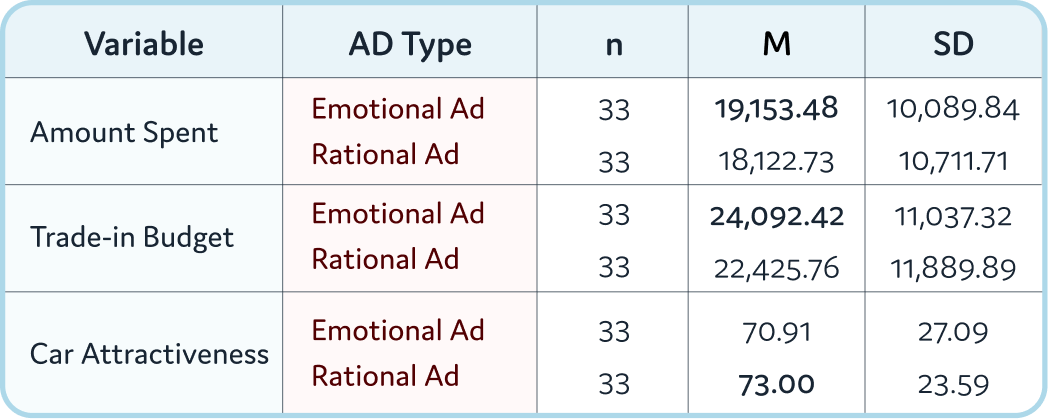
Emotional ads were predicted to lead to higher spending, but results were not statistically significant.
Even though participants exposed to the emotional advertisement spent slightly more on average ($19,153.48) and tended to allocate a higher trade-in budget, a one-way ANOVA revealed no statistically significant differences across ad conditions for any dependent variables (Amount Spent, Trade-in Budget, or Attractiveness). Amount Spent: F (1, 64) = 0.16, p = .689
Reflection
Re-evaluating the Impact of Emotional and Rational Appeals on Consumer Decision-Making
Emotional appeal remains a powerful tool in advertising, as supported by prior research. While this study did not find significant differences in spending behavior, future research with broader samples and improved controls is necessary to determine the true impact of emotional versus rational ads on consumer decision-making.
Uncontrolled Variables
Age, brand loyalty, and personal experience may have affected results but were not measured.


References & Further Reading
Achar, C., So, J., Agrawal, N., & Duhachek, A. (2016). What we feel and why we buy: The influence of emotions on consumer decision-making. Current Opinion in Psychology, 10(1), 166–170. https://doi.org/10.1016/j.copsyc.2016.01.009
Akbari, M. (2015). Different impacts of advertising appeals on advertising attitude for high and low involvement products. Global Business Review, 16(3), 478–493. https://doi.org/10.1177/0972150915569936
Lee, S., & Heere, B. (2018). Exploring the relative effectiveness of emotional, rational, and combination advertising appeals on sport consumer behavior. Sport Marketing Quarterly, 27(2), 82–92. https://doi.org/10.32731/SMQ.272.062018.02
Lerner, J. S., Li, Y., Valdesolo, P., & Kassam, K. S. (2015). Emotion and decision making. Annual Review of Psychology, 66(1), 799–823. https://doi.org/10.1146/annurev-psych-010213-115043
Nike. (2024, August 26). Great athletes remind the world there’s nothing wrong with wanting to win. Nike.com. https://about.nike.com/en/newsroom/releases/winning-isnt-for-everyone-campaign
Vrtana, D., & Krizanova, A. (2023). The power of emotional advertising appeals: Examining their influence on consumer purchasing behavior and brand–customer relationship. Sustainability, 15(18), 13337. https://doi.org/10.3390/su151813337